
Country Balls: Power Protocol
MAD PIXELStrategy
3.9213.00 Reviews
- Version
- 0.2.2
- Installs
- 100.00K
- Age Rating
- Teen
Screenshots
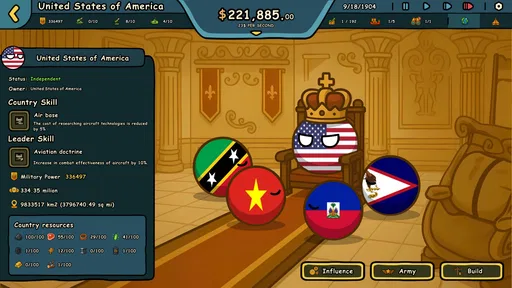
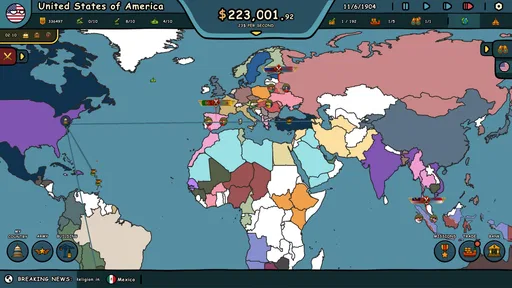
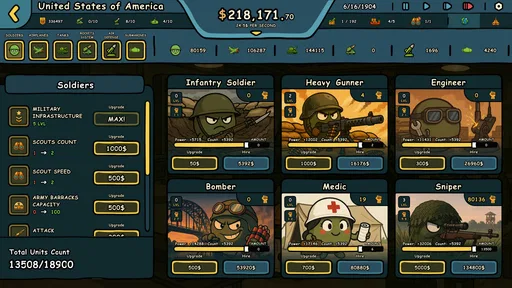
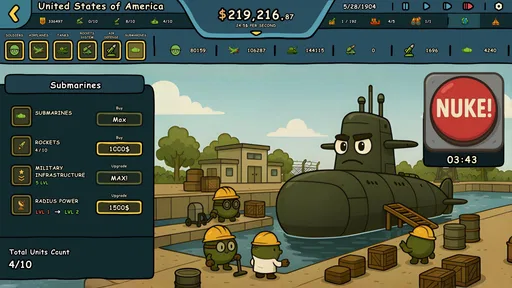
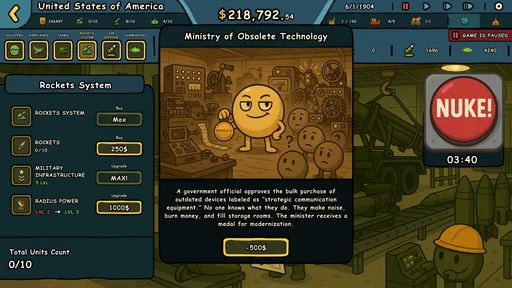
Our Review of Country Balls: Power Protocol
 Analysis by Appyee
Country Balls: Power Protocol is a strategy game from MAD PIXEL that puts me in charge of a cartoon-style countryball empire. Its central appeal is easy to understand: I tap, build, expand, and try to turn a small operation into a force capable of taking over the map. That sounds simple, but the interesting part is deciding where my attention matters most and when expansion is worth the risk.
I spent time with it as a lightweight strategy experience rather than expecting a full grand-strategy simulation. The game is free to start, carries a Teen content rating, and has a 3.9 average from around 4.6 thousand ratings. With over 100 thousand installs, it has already found an audience, although its current version, 0.2.2, still gives the impression of a project that is developing rather than a finished, enormous strategy platform.
My short version is this: Country Balls: Power Protocol works best when you want quick strategic decisions wrapped in a playful countryball presentation. It is less suitable if you want detailed diplomacy, long-form historical simulation, or a strategy game where every system is explained with complete precision.
Where the real decisions begin
The first thing I noticed is that the game makes expansion feel immediately tempting. Building up and pushing outward are obvious goals, so it would be easy to treat every available action as progress. In practice, I found it more useful to pause mentally before spending resources or committing to the next step. A larger territory is only valuable if I can support it and continue making progress afterward.
That creates a useful decision space even within the game’s accessible format. I am constantly weighing immediate growth against a stronger position later. Should I improve what I already control, or use the current opportunity to expand? Should I spend now for visible progress, or hold back so the next important action is not delayed? These are not complicated questions individually, but they become meaningful when several demands arrive close together.
My preferred approach was to establish a dependable base before becoming too ambitious. I treated early gains as preparation rather than proof that I could safely rush forward. This made later choices clearer because I had a better sense of what I could afford to risk. Players who tap through every available action without considering the next few moves may still progress, but they are likely to feel more friction when the game asks for a larger commitment.
The countryball theme helps here because it keeps the mood light. The presentation does not make me feel as though I am managing a spreadsheet. Instead, the visual identity gives the strategic choices a humorous surface while leaving room for planning underneath. That combination makes the game approachable for someone who normally avoids serious strategy titles.
Planning beyond the next tap
A useful habit is to think in short planning horizons. I found that planning only one action ahead made the game feel reactive, while considering the next small sequence gave me more control. I would first identify the improvement or expansion I wanted, then ask what it would require immediately afterward. That simple check helped me avoid using everything on a single attractive move.
This is also where the game differs from a purely idle experience. The tapping and building language suggests quick interaction, but the best results come from paying attention to timing. I did not need a complicated written plan. I only needed to know whether my next decision supported a stable position or merely produced a satisfying number on the screen.
For a short evening session, this works well. I can open the game, make a few decisions, and leave without needing to remember a huge web of systems. At the same time, the basic loop has enough room for personal play styles. One player may prefer steady development, while another may enjoy pushing aggressively and accepting setbacks. The game’s charm comes from letting those approaches feel different without burying the player in technical detail.
The trade-off behind every expansion
Expansion is the game’s most obvious reward, but it is also where I felt the clearest risk. Taking more territory or pursuing a larger goal creates momentum, yet momentum can encourage careless spending. I often had to decide whether a gain was genuinely improving my position or simply making the empire look bigger for the moment.
I recommend treating expansion as an investment rather than a trophy. Before pushing forward, I considered whether I had enough room to recover from an inefficient choice. If the answer was no, strengthening the current position was usually the more sensible move. That does not mean playing defensively all the time. It means choosing aggression when it opens a useful path instead of using it automatically.
This risk-and-reward balance is especially important for free players. Country Balls: Power Protocol is free to download, but it includes in-app purchases ranging from $0.99 to $49.99 per item. I would approach those purchases carefully. A payment can make a short session more convenient, but it should not replace learning the game’s timing. I would first decide whether I enjoy the core loop without spending, then consider whether an optional purchase genuinely improves my experience.
That advice matters because quick strategy games can make immediate progress feel more valuable than it really is. When an upgrade or expansion is visible, spending can seem like the natural answer. I got more satisfaction from delaying that impulse and seeing whether a better sequence of decisions could achieve the same goal. Players who dislike any form of purchase pressure should keep this structure in mind before committing to the game.
How I handled setbacks
The most useful counterplay is not simply reacting to a setback after it happens. It is leaving myself enough flexibility that one poor decision does not ruin the entire session. I tried to avoid spending every resource as soon as it became available, because a reserve gave me more options when the situation changed.
I also learned to separate emotional progress from practical progress. Losing momentum can feel frustrating, especially after building toward a particular expansion. However, immediately chasing the lost ground can create a second mistake. A calmer response is to reassess what remains strong, restore the foundation, and then choose a new route forward. That mindset turned difficult moments into planning problems instead of reasons to abandon the session.
For new players, I would recommend experimenting with two contrasting styles. First, play conservatively and see how far steady development takes you. Then try a more aggressive approach and notice where the extra pressure appears. The comparison teaches more than simply repeating the same safe pattern, because it reveals which decisions are genuinely powerful and which only feel exciting.
Adapting as the empire changes
One strength of the game is that it encourages adaptation without demanding that I memorize a large rulebook. My priorities changed depending on how much progress I had already made. Early decisions were about establishing a workable base. Later decisions were more about preserving momentum and choosing the most efficient direction for continued growth.
I found it helpful to review my position whenever the next goal became less obvious. Instead of tapping through the familiar action, I asked what had changed. Did I have a stronger platform now? Was my previous plan still realistic? Would a smaller improvement give me more options than a dramatic expansion? These questions kept the experience from becoming a completely automatic routine.
That flexibility is also the best way to deal with the game’s lighter presentation. Country Balls: Power Protocol is not trying to overwhelm me with layers of historical context or detailed political simulation. Its strategy comes from prioritization, timing, and resource discipline. If I expect a complex model of international relations, I will probably find the experience too simple. If I want a readable game where the main challenge is making better choices than I made a minute ago, the format is more appealing.
A practical routine for short sessions
My most effective everyday routine was to begin by checking the current position rather than immediately selecting the most obvious action. I looked for the upgrade or expansion that would improve my next few decisions, not only the one that produced the largest immediate result. Then I kept enough flexibility for a follow-up move instead of ending the sequence with nothing left to work with.
This approach fits a common mobile situation: I might have a few minutes while waiting for an appointment or taking a break. I can make meaningful choices without needing to dedicate an entire evening. When I have more time, I can test a different plan and compare the results. That makes the game easy to revisit, because each session can focus on a different question: faster growth, safer preparation, or better recovery after a mistake.
The trade-off is that the experience may feel repetitive if I only repeat the same successful routine. I got more from it when I deliberately changed my priorities. A player who wants constant surprises may eventually want more variety than this compact structure provides. A player who enjoys refining a familiar loop will likely appreciate the opportunity to improve decision quality gradually.
Who should play and who should skip it
I would recommend Country Balls: Power Protocol to players who like approachable strategy, cartoon presentation, and the satisfaction of turning small improvements into a larger empire. It is a good fit for someone who wants to practice prioritization without learning a dense collection of systems first. The countryball style also makes it easier to suggest to friends who enjoy humorous games but still want choices to matter.
I would be more cautious about recommending it to players seeking a deep alternative to traditional grand-strategy games. Those games usually offer broader diplomacy, more detailed economies, and longer campaigns built around complex interactions. This title is more immediate and compact. Its appeal comes from quick decisions and accessible growth, not from simulating every part of running a nation.
I would also skip it if I strongly dislike in-app purchases in free games, even though the game can be started without an upfront price. The purchase range reaches from $0.99 to $49.99 per item, so anyone sensitive to optional spending should set a personal limit before playing. That is a practical decision, not a judgment on the game itself.
Depth that grows through better choices
The game’s long-term depth comes less from learning dozens of separate mechanics and more from improving how I sequence decisions. At first, I focused on making progress. After more time, I paid greater attention to what each action enabled or prevented next. That change in perspective gave the loop more substance than the simple tap-and-expand premise suggests.
A non-obvious strength is that restraint can be an active strategy. Holding back is not automatically passive if it protects a future option. I often found that a modest improvement created a better launch point than a risky push that looked more impressive. This is the kind of lesson that transfers well to other strategy games: the strongest move is sometimes the one that keeps several good moves available later.
Another useful insight is to judge a plan by its recovery cost. Two actions may offer similar progress, but one may leave me able to correct a mistake while the other forces a long rebuild. When I considered that difference, my play became less focused on maximum short-term growth and more focused on sustainable momentum. That made the game feel more strategic without requiring any invented complexity.
The third insight is to use experimentation as a form of progression. Rather than assuming that one play style is correct, I tested conservative and aggressive approaches, then watched how each affected the next decision. This is particularly valuable for players who are new to strategy games because it turns failure into information. The game becomes a small laboratory for learning how risk changes the shape of a campaign.
How it compares with familiar strategy choices
Compared with an idle builder, this game asks me to think more actively about what to do with the progress I have earned. The interaction is still quick and accessible, but I do not get the same satisfaction from simply waiting for numbers to rise. My choices feel more important when I consider their order and consequences.
Compared with a grand-strategy game, it is much easier to enter and leave. I do not need to commit to a lengthy campaign or understand a wide political system before I can enjoy the basic loop. The cost of that accessibility is reduced depth in the broader simulation. Players who want detailed diplomacy or a large number of interacting national systems will find the usual alternatives more rewarding.
Compared with a pure clicker, Country Balls: Power Protocol benefits from its emphasis on building and expansion decisions. The tapping gives the game immediacy, while the empire theme gives those taps a direction. Still, anyone expecting every click to reveal a new strategic layer may find the experience more limited. Its strongest moments come from planning within a focused framework, not from endless mechanical variety.
What the current version means for expectations
The game was released on November 27, 2025, and the current version is 0.2.2. I mention that because it is useful context when deciding how much polish and breadth to expect. My experience suggests approaching it as a developing strategy game with a clear central idea, rather than assuming it already offers the scale of a mature genre leader.
That does not make it a poor choice. In fact, the focused design is part of its appeal. I would rather see a small game make its main loop understandable than add layers that do not improve decision-making. The important question is whether the current scope matches what I want. For short sessions and light strategic planning, it does. For a definitive, all-encompassing empire simulator, it does not.
My strategy verdict
Country Balls: Power Protocol is a free strategy game with a playful identity and a more thoughtful decision loop than its simple presentation initially suggests. I enjoyed deciding when to build, when to expand, and when to preserve options for the next move. Its best quality is the way it turns small choices into a lesson about planning horizons: immediate progress matters, but the position I create afterward matters more.
Its limitations are equally clear. The experience is not aimed at players who need elaborate diplomacy, deep historical systems, or a completely purchase-free environment. The in-app purchase range deserves attention, and the current version feels better suited to focused mobile sessions than to replacing a full-scale strategy game.
For me, the recommendation depends on expectations. If you want a countryball-themed game that lets you build an empire through quick but meaningful choices, I think MAD PIXEL has made a promising option. If you prefer complex simulations or dislike the structure of free-to-play games, I would choose a different strategy title. Otherwise, I would start slowly, protect my options, and treat every expansion as a decision with a future cost—not merely another tap to make.
Verdict
Strengths of Country Balls: Power Protocol
- Funny countryball humor makes the strategy experience approachable.
- Short missions suit quick mobile gaming sessions.
- Distinct nations encourage experimenting with different play styles.
- Bright visuals make units and maps easy to recognize.
- Progression gives players reasons to return and improve tactics.
Limitations of Country Balls: Power Protocol
- Some jokes may feel repetitive after extended play.
- Difficulty can rise sharply in later missions.
- Certain upgrades may require considerable grinding.
- The small interface can feel crowded on compact screens.
- Internet access may be needed for some features or rewards.
Other Releases by MAD PIXEL
View All
Idle Sword Master
Simulation4.4
Similar Picks in This Category
View All
Clash of Clans
Supercell4.5

Plants vs. Zombies™
ELECTRONIC ARTS3.7

Lords Mobile: Kingdom Wars
IGG.COM4.5

Clash Royale
Supercell4.4

State.io — Conquer the World
CASUAL AZUR GAMES4.1

Car Driving School : Car Games
Spark Game Studios3.9
Frequently Asked Questions
What is Country Balls: Power Protocol?
Country Balls: Power Protocol is a strategy game built around humorous country-ball characters, territorial expansion, resource management, and tactical decisions. Players typically develop their nation, recruit or upgrade units, complete missions, and compete against opponents. Its lighthearted visual style makes it approachable, but progression still requires planning because choosing where to invest resources can strongly affect battles and long-term development.
Is Country Balls: Power Protocol free to download and play?
The game is generally available as a free download, allowing players to begin without an upfront purchase. However, free-to-play games commonly include optional in-app purchases, such as premium currency, bundles, cosmetic items, or progression boosts. Before spending money, check the store listing and the in-game purchase menu carefully, especially if children may use the device, because some upgrades can make progress faster rather than being essential.
Does the game require an internet connection?
An internet connection may be needed for important features such as account synchronization, advertisements, events, online competition, cloud saves, and receiving new content. Some parts of the game may remain accessible offline, but this can vary by version and device. For the most reliable experience, play while connected to Wi-Fi or mobile data and avoid assuming that offline progress will always be saved.
Is Country Balls: Power Protocol suitable for children?
The colorful country-ball presentation and comedic tone may appeal to younger players, but parents should still review the game’s content and monetization features before allowing regular play. Strategy games can include combat, competitive mechanics, advertisements, timers, and optional purchases. Checking the official age rating, disabling unauthorized purchases, and discussing screen-time limits are sensible precautions for younger users.
What should new players know before starting?
New players should avoid spending premium resources immediately and first learn how missions, upgrades, units, and rewards work. Early progress is usually smoother when resources are focused on a balanced team rather than spread across every available option. Completing daily objectives and limited-time activities can also provide useful materials. Because updates may change balance or available features, consult the latest in-game information before committing to a long-term strategy.
Play our best games!


